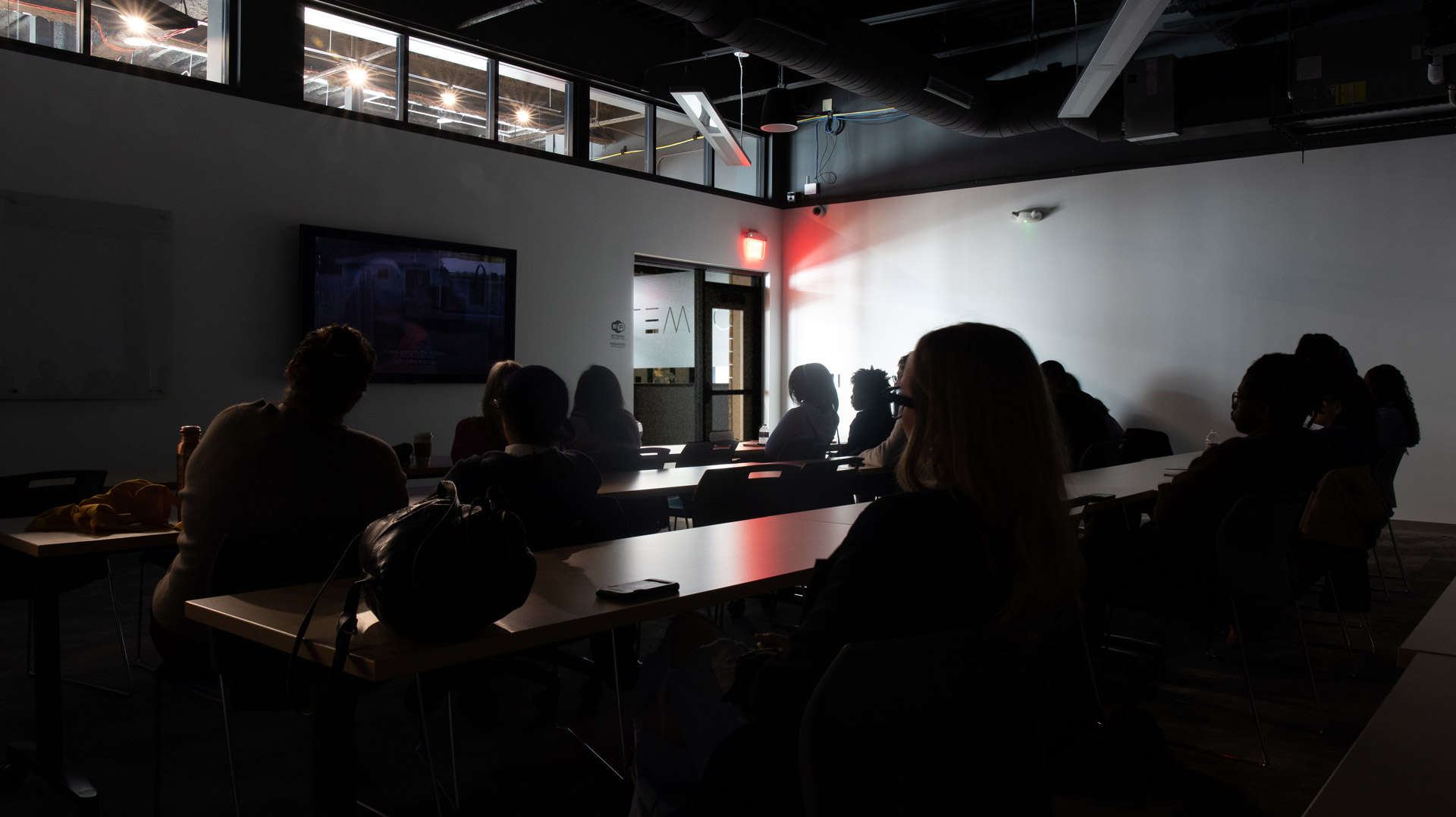
On a Saturday morning in April, teenagers gathered at 3rd Street Market Hall and sat down to watch a documentary about mathematics.
They came on their own. Nobody made them.
The conference room they filled isn’t a classroom. It’s not a rec center or a community center or any of the spaces Milwaukee typically sets aside for young people and calls it enough. It’s the same building where the city goes to eat, to gather, to be seen. And on April 11, it was where TRUE Skool2 students Cam and Zion stood in front of a room of educators, organizers, and community members — and led one of the more honest conversations about learning that Milwaukee has had in a while.
What followed the screening of Counted Out7 — a 2024 documentary that frames math literacy as nothing less than a civil rights issue — was less a talkback and more a reckoning.
The event was hosted at 3rd Street Market Hall1 — and it was the public face of something that’s been quietly building inside TRUE Skool‘s weekly programming all spring.
This spring, the Milwaukee-based nonprofit — operating since 2004 and using Hip Hop culture as a vehicle for youth empowerment — has been running a Monday session called “Do the Math.” The initiative sits at the intersection of the arts and mathematics, and it’s growing out of a partnership that includes UWM’s Department of Mathematical Sciences, STEAM Milwaukee4, LearnDeep3, and WOSTA5, collectively known as the Milwaukee Math Collaborative. Funding comes through STEM Next‘s Project R³: Redefining Relationship to Math.6
The premise is deceptively simple: what happens when you stop asking young people to learn math in the abstract, and instead meet them inside the things they already love?
At TRUE Skool, that means hip hop. It means beat production, DJing, visual art, film, fashion. It means showing a student who makes music that the circle of fifths is a mathematical structure, that harmonic frequencies are numbers in motion, that the rhythm they feel in their chest has been a function of ratio since long before anyone handed them a worksheet about it.
“There are many ways math intertwines with music,” Cam told the room before the film began, introducing the initiative to an audience that included community members, educators, and environmental justice organizers. “Rhythm. Notation. How composers compose. Ratio. Music theory, the circle of fifths.”
He wasn’t lecturing. He was inviting.
The deeper argument underneath Do the Math — and underneath Counted Out — is that the problem was never the students.
The film, directed by Vicki Abeles and dedicated to civil rights leader Bob Moses,9 makes the case that math illiteracy in America is not a failure of aptitude but a failure of design. That the way math is taught — rigid, abstract, sequential, sorted — has historically served to filter people out rather than bring them in. That when only 24% of the country reaches mathematical proficiency,8 that’s not a coincidence. It’s the system doing exactly what it was built to do.
Pete Reynolds of LearnDeep, who helped organize the screening and has been collaborating on the Milwaukee Math Collaborative’s work with TRUE Skool, offered a piece of local context before the film rolled. The Algebra Project — one of the film’s central subjects, Bob Moses’ decades-long effort to treat math access as civic access — wasn’t foreign to Milwaukee. It was here. Running in the 1980s, through a couple of churches.
“Some of this has been here before,” Reynolds said. “It’s not coming back from somewhere else.”
That framing matters. Milwaukee doesn’t need to import a movement. It needs to remember one it already had, and build from there.
After the film, Cam and Zion stood in front of the room and did something most people twice their age struggle to do in public: they were honest about what they don’t know.
“I’m personally not that great at math,” Zion said, opening the talkback. “I do my best.”
It’s a line that could easily read as deflection. In context, it was an act of leadership — naming a truth the room recognized before asking the room to think about why that truth exists.
Cam followed. “I always struggled with math when I was younger, and I feel it’s more likely because of how we fundamentally learn early on.” He talked about how some kids arrive at school with math already woven into their home life — parents in finance, in economics, in technical fields — and how other kids don’t. How that gap compounds silently, year after year, until the kid who needed more time is labeled as someone who just isn’t built for it.
“The way we’re presented with learning can be different,” Cam said. “And that’s a fault of the education system. It’s designed to set some of us up to struggle.”
Both students connected math’s failures to music theory’s parallel exclusions — how the formal structures of Western musical notation, codified centuries ago for a specific class of people, show up in today’s classrooms with the same gatekeeping energy. How today’s producers, rappers, and beatmakers are doing advanced mathematical work without ever being told that’s what it is.
“I never really thought mathematics played a role in music,” Cam said. “I just thought I’m going to make beats, write lyrics, punch in. But it actually does play a role — in harmonic frequencies, chord variations. All of those have numbers. All of those are mathematical.”
Zion pushed further, introducing the room to the concept of first principles thinking — an engineering framework his software developer father had been working through — as a way to describe what genuine education reform might look like. Strip the subject down to its most fundamental components. Forget the accumulated assumptions about how it’s supposed to be taught. Start from the question a child would actually ask. Build from there.
“To restructure how we learn, we have to be willing to forget our current way of learning,” he said. “That’s how we can reach new thoughts.”
The room responded.
A teacher with 40 years in the profession leaned in with a question that carried the weight of four decades of professional frustration: while we wait for institutions to change, what can individual teachers do? What would have made you feel like you weren’t a burden?
Zion described a Project Pipeline architecture program11 — a real-stakes design challenge built around helping people like Glenn,10 a man featured in Counted Out who used mathematical reasoning to understand the legal system and ultimately earn his release from prison. The assignment asked Zion to design spaces that would be more open and nurturing for mental health. The math had a purpose. It had stakes.
“That inspired me to think deeply,” he said, “and it helped me ground my math way better.”
Cam offered something simpler and equally important: he needed teachers who asked how he learned, not just whether he was learning. The ones who did — who gave him multiple sources, who worked through problems alongside him rather than in front of him — made the difference. The ones who didn’t left him sitting quietly in rooms where he didn’t want to ask questions because the environment itself made asking feel dangerous.
“I didn’t want to be a burden,” he said. “I felt like I was just holding everyone back.”
That sentence — repeated in different forms by both students across the talkback — is the one that should stop every educator cold. The students weren’t disengaged. They were protecting themselves from rooms that hadn’t been made safe enough to not know something.
After the session, Karen — attending as part of ReFlow and the Environmental Youth Collaborative, a partner organization of TRUE Skool — reflected on a perspective that linked math to something even larger than the classroom.
Her biggest takeaway from Counted Out, she said, was about voice. About who gets to be at the table when problems are being solved. About how math proficiency has historically functioned as the price of admission to those conversations — and how that price has not been charged equally.
“How important it is to have diverse minds at the table,” she said. “And how important voice is. How do you build that voice? How does someone who has a seat at the table actually get to participate?”
That question doesn’t stay inside a math classroom. It shows up in city planning meetings, in environmental policy negotiations, in technology that runs on algorithms most people will never see. Counted Out makes the case that math is the language of power in the modern world — and that teaching young people to hate it, or to believe they simply can’t do it, is one of the quieter ways power maintains itself.
In a conversation after the event, Fidel, co-executive director of TRUE Skool, reflected on what the morning represented.
“Math is intertwined in everything we’re doing in life,” he said. “Now it’s a matter of figuring out how we communicate, share resources, share best practices — and figure out how to really impact students where they are.”
He noted what the room itself represented: young people and educators gathering on a Saturday morning, voluntarily, to sit with hard questions about learning and equity. No grades attached. No requirement. Just curiosity, and a shared sense that something in the system needs to give.
“It all adds up,” he said. “Do the math.”
A spring showcase is coming. TRUE Skool students will present their “Do the Math” projects publicly — work that has spent the last several months growing at the intersection of music, mathematics, and lived experience. The details haven’t been announced yet, but the conversation that happened Saturday morning suggests the presentation will be worth showing up for.
What Cam and Zion demonstrated in that second-floor room — the ability to hold a sophisticated argument about pedagogy, race, access, and the future while standing in front of a room of adults who’ve spent careers thinking about these things — is precisely the thing that the current model of math education would have never thought to measure.
They didn’t fail math. Math failed to find them.
Something in Milwaukee is trying to correct that. The beats are already there. The numbers are already in the music. Someone just finally said so out loud.
TRUE Skool‘s Do the Math initiative runs through their spring after-school sessions in partnership with the Milwaukee Math Collaborative — UWM Department of Mathematical Sciences, STEAM Milwaukee, WOSTA, and LearnDeep — with funding through STEM Next‘s Project R³. Follow TRUE Skool at @trueskool414 and visit trueskool.org for updates on the upcoming Spring Showcase Gallery.
Counted Out is available for community screening at countedoutfilm.com.
Notes
1 3rd Street Market Hall is a public food and retail market in downtown Milwaukee at 275 W. Wisconsin Ave. In late March 2026, the venue implemented a policy requiring guests under 18 to be accompanied by an adult following a series of teen takeover incidents at locations across the Milwaukee area, including Bayshore Mall and Moody Park. The April 11 event was organized and attended voluntarily by TRUE Skool youth participants.
2 TRUE Skool, Inc. was founded in 2004 and incorporated as a 501(c)(3) nonprofit in 2005. trueskool.org
3 LearnDeep Milwaukee is a nonprofit focused on accelerating innovation in Milwaukee-area schools through community-engaged, project-based learning. learndeep.org
4 STEAM Milwaukee is a resource library and learning hub that lends hands-on science, technology, engineering, art, and mathematics equipment to classroom teachers and youth leaders. steammilwaukee.com
5 WOSTA (Wisconsin Out of School Time Alliance) is the state affiliate of the national 50 State Afterschool Networks, bringing together organizations across Wisconsin to expand access to quality out-of-school time programs. wiafterschoolnetwork.org
6 STEM Next Opportunity Fund is a national nonprofit leading the movement to make out-of-school STEM learning available to all young people. Project R³ (Redefining Relationship to Math) is a STEM Next-funded initiative. stemnext.org
7 Counted Out. Directed by Vicki Abeles. Reel Link Films, 2024. countedoutfilm.com
8 The 24% figure refers to the share of U.S. adults and students meeting mathematical proficiency benchmarks, as cited in Counted Out.
9 Bob Moses (1935–2021) was a civil rights leader and founder of the Algebra Project, which holds that math literacy is a civil rights issue. The Algebra Project operated in Milwaukee in the 1980s. Moses is a central subject of Counted Out.
10 Glenn Rodriguez is featured in Counted Out. Imprisoned at 16 and repeatedly denied parole despite exemplary behavior, Rodriguez challenged a proprietary risk-assessment algorithm by collecting data from fellow inmates and reverse-engineering the formula. His mathematical analysis helped make the case that the algorithm was flawed, ultimately contributing to his release. He is now Deputy Director at the Center for Community Alternatives.
11 Project Pipeline is a free summer architecture program for middle and high school students from underrepresented communities, run by the National Organization of Minority Architects (NOMA).
Leave a Reply