
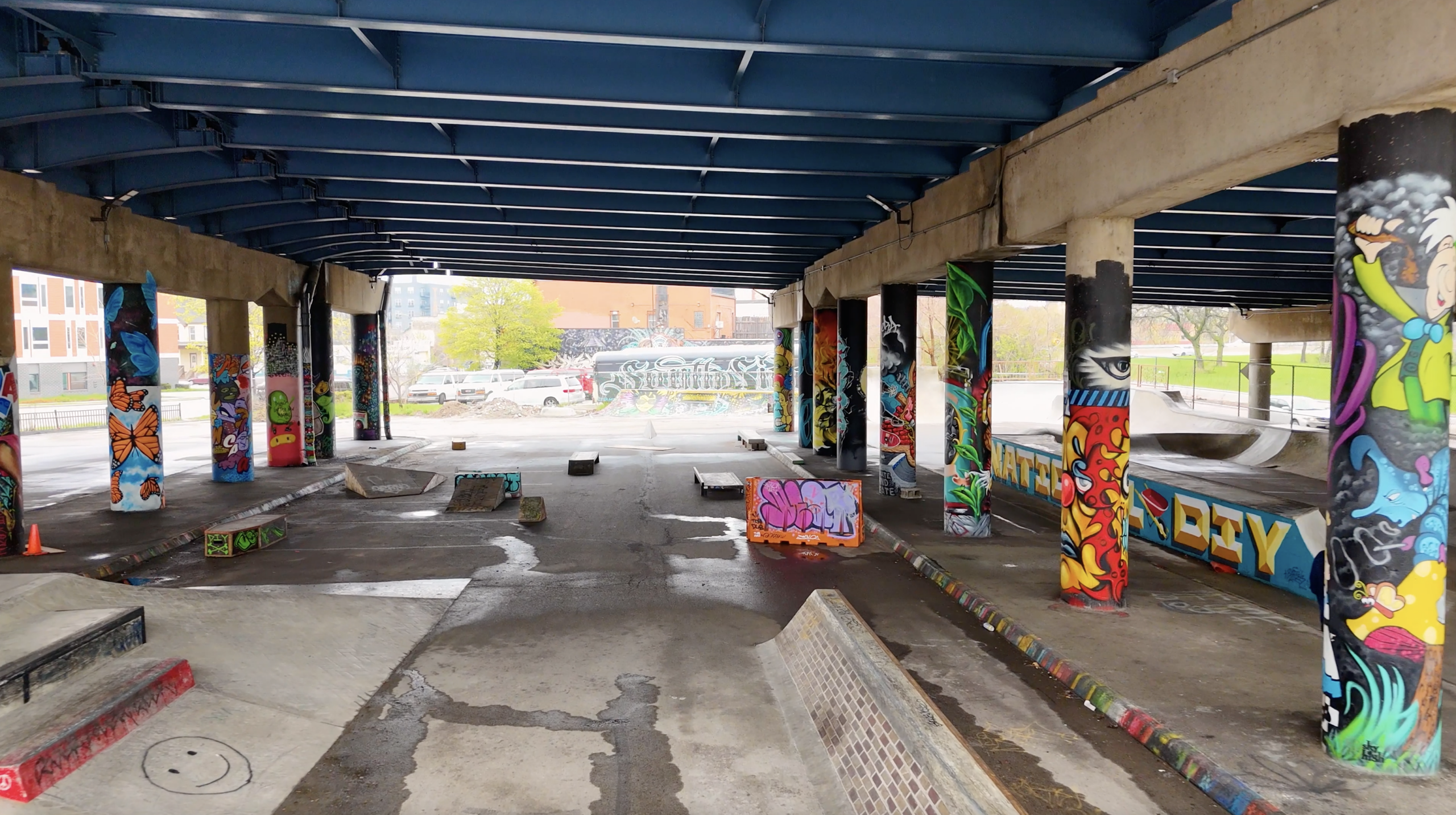
The interstate that runs through Walker’s Point was built in the 1960s to move traffic through a neighborhood the city had other plans for. Today, trucks and semis roll along I-43 in a steady overhead thunder while below, on a stretch of open asphalt between 6th and 9th on National Avenue, murals climb the concrete columns and quarter pipes line the ground. The freeway was built to move people through Walker’s Point. What gathered underneath it was not part of the plan.
This is National DIY Skatepark. It is free, open and built entirely by people who had a different vision for this corner of the city than the city did.
Cities have always been comfortable designing on-ramps and off-ramps, and before that, rail lines that moved goods through neighborhoods rather than for them. Vert ramps and skate rails were never in the plan.
During the pandemic, skaters began building ramps on neglected asphalt that had long been associated with illegal activity and the kind of disuse that collects in places no one claims. No permits. No city backing. Just a space and a reason to return to it. Neighbors supported the effort because regular presence had already begun to change the character of the lot. People showing up every day to build something displaced the activity that had troubled the block for years.
The city recognized what had happened and eventually helped formalize it. A grassroots campaign raised over $15,000 for concrete, tools and maintenance. A $100,000 city grant followed, funding fencing, lighting and improvements. The project incorporated as a nonprofit. Last year it received the Brewers Community Foundation Public Space Award at the Milwaukee Awards for Neighborhood Development Innovation and a Mayor’s Design Award. In under five years, an illegal DIY build had become civic infrastructure.
The community did not form because an institution built the space. The institution recognized the space because the community had already formed.
That sequence matters more than usual right now.
This spring, two long-running indoor skateparks in the area closed. Four Seasons Skate Park in the Menomonee Valley shut down after 27 years when the building housing it was sold (TMJ4). Cream City Skatepark in Butler closed April 12 after losing its lease, ending a 20-year run. “We’ve had over 30,000 skateboarders come here in the 20 years we’ve been here,” co-owner Bill Kaschner told FOX6. Both parks had built real communities. Neither controlled the ground beneath them.
Walker’s Point has always thought differently about space. The neighborhood has a long habit of finding value in what the rest of the city overlooked, industrial buildings that became studios and restaurants, underused corners that became something worth returning to. It is Milwaukee’s oldest neighborhood and in some ways its most adaptive, shaped less by what was planned for it than by what people decided to do with what was left (Encyclopedia of Milwaukee). National DIY fits that pattern, though in a more improvised and more unlikely form than most.
The infrastructure built to divide a community became the shelter for one. That reframing, of what a space is for, of who it belongs to, of what a neighborhood can absorb and transform, is the Walker’s Point model. It did not originate with a master plan. It never does. It originates with people who looked at ground the city had written off and decided it was worth fighting for.
George Walker staked his original claim here in 1834 and lost it to a land jumper within a year. It took him nearly a decade to win it back. The neighborhood that carries his name has been making the same argument ever since. This is our space. We will find a use for it.
A skatepark under the freeway is just the latest proof.
Leave a Reply